Key Takeaways
•A strong candidate for value-focused buyers in Natick right now is West Natick — it pairs commuter-rail access with list prices below Newton and Wellesley.
•The market has calmed, but it still favors sellers. According to the June 2026 reports cited here, Natick is a "balanced" market where homes still close slightly above asking, so this is a more workable moment for buyers than a true bargain window.
•The trade-offs are real. Natick still moves fast, West Natick's train parking fills early, and weekend rail service is thin — so you need a plan, not panic.
•The bottom line: For commuters and families wanting long-term roots, West Natick offers a practical mix of relative value, connectivity, and community in MetroWest — though Natick Center is a legitimate competing choice for buyers who prioritize walkability and downtown amenities.
Everyone keeps telling you the same thing.
Natick is too competitive. You'll get priced out before you even fall in love with a home.
Here's a more useful way to look at it.
West Natick is a practical entry point for value-focused buyers right now. The wider Natick market has softened. The pace has calmed. And a commuter-friendly lifestyle that costs meaningfully less than Newton or Wellesley is sitting right there, largely overlooked.
So if your real question is, "Which Natick neighborhood fits a value-focused buyer?" the answer we land on is West Natick — with one honest caveat. Natick Center competes closely, and we explain why below.
We compare West Natick with South Natick, Natick Center, and Wethersfield, then show you where West Natick stands out on price, access, schools, and daily life — and where it doesn't.
One disclosure up front: several market observations in this article come from Steinmetz Real Estate, a local agency that earns commissions on Natick home sales. We treat their quotes as informed local opinion, not neutral analysis, and pair them with independent data — Redfin, U.S. News, and the placed market reports — wherever possible.
Why Is West Natick a Value Play Right Now?
The first reason is straightforward: price.
According to Redfin, Natick's median sale price has fallen over the past year — one of the clearer signals that the town has cooled from its recent peak. That kind of dip is unusual in a market that has historically favored sellers.
One important caveat: this is a town-wide figure, not a West Natick-specific number. The same softening benefits a buyer in South Natick, Natick Center, or Wethersfield just as much. The price dip is a reason to look at Natick overall right now — not proof that West Natick alone is discounted. West Natick's case rests on its combination of relative value and rail access, which we cover below.
It's also worth being clear about what "median sale price" and "list price" actually mean. A sale price is what a home closed for. A list price is what the seller asked. The comparison table below shows June 2026 list medians, which is why its figures differ from the Redfin sale-price trend above.
Natick and Neighboring Town Median Price Comparison
Compares June 2026 Natick median home price estimates with Newton and Wellesley median price benchmarks discussed for the Natick buyer value comparison.
| Category | Median Price | Source |
|---|---|---|
| Natick (list, June 2026) | about $899K | BMN Boston |
| Natick (alternate estimate) | $924K | Steve Novak market report |
| Newton | $1.3M+ | Steinmetz Real Estate |
| Wellesley | $1.6M+ | Steinmetz Real Estate |
That gap matters for your budget.
Local agents at Steinmetz Real Estate describe Natick as offering "meaningful value relative to Newton and Wellesley." Because Steinmetz sells homes in Natick, treat that as an interested opinion — but the list-price comparison above supports the same basic point independently.
Within Natick, West Natick is one of the more affordable entry points. You still get the town's schools, commuter access, and municipal services without chasing the priciest addresses.
What this means for you: West Natick gives you a workable shot at buying into Natick without stretching into Newton or Wellesley pricing.
Why Does West Natick Work Well for Commuters?
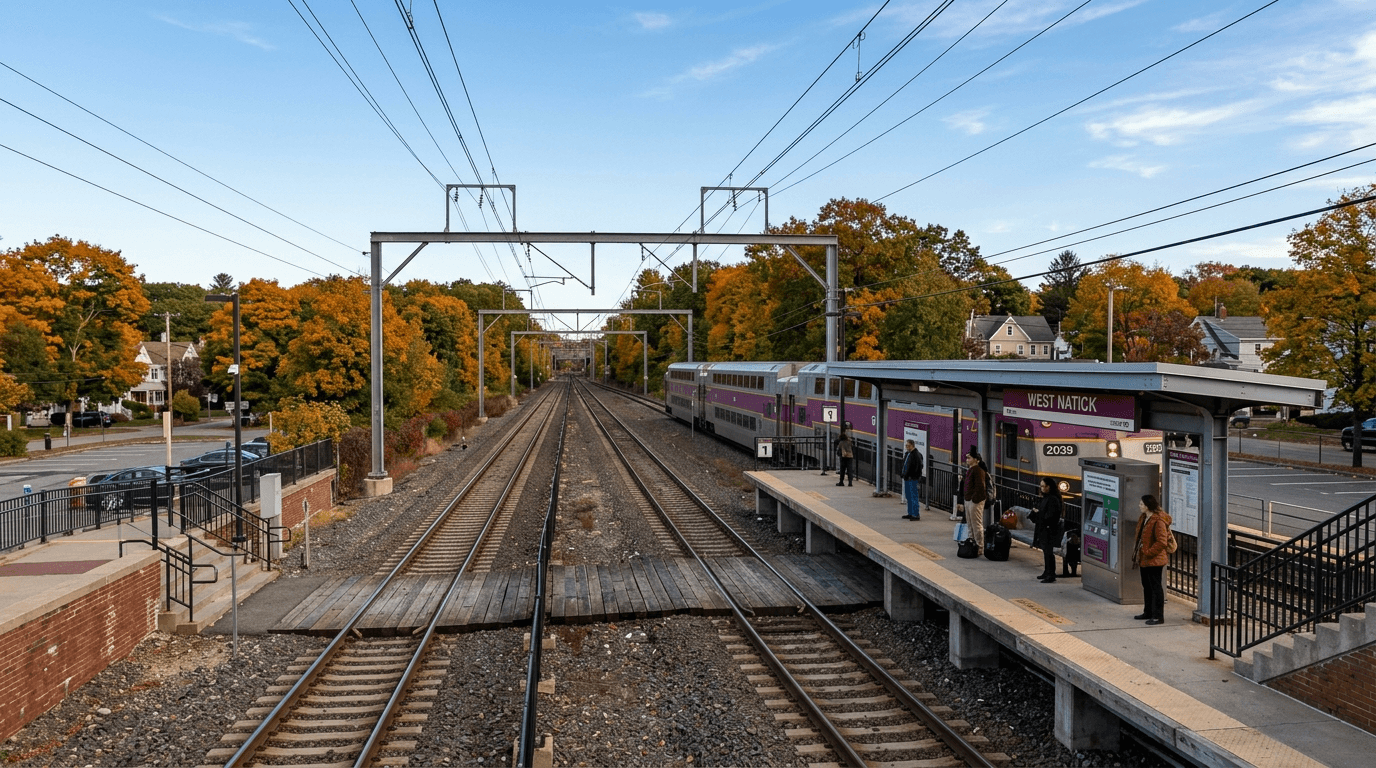
West Natick's signature feature is its own commuter-rail station on the Framingham/Worcester Line — a direct rail option toward Boston without paying a closer-in suburb premium.
Route 9 adds another layer of flexibility. Some days the train makes sense. Other days, driving works better. For hybrid workers, that optionality is a genuine advantage, not just a talking point.
Steinmetz Real Estate points to the town's mix of commuter rail, Route 9 employment, and the Natick Mall as a regional draw for professionals. As a selling agency, they have reason to emphasize this — but the rail station and Route 9 access are verifiable features, not marketing spin.
An honest limit on this advantage: Natick Center also has its own commuter-rail station, plus stronger walkability and a livelier downtown. Rail access alone doesn't make West Natick the obvious winner. Its edge is narrower: it tends to offer more house for the money than Natick Center while still keeping a station within reach. If downtown walkability matters more to you than price, Natick Center may be the better fit.
Best for: Boston commuters who want rail access and want to spend less than they would in Newton or Wellesley — and who value price over downtown energy.
What Kind of Community Does West Natick Offer?
Price gets you interested. Community is what makes you stay.
West Natick is known as a lived-in, diverse neighborhood — practical rather than polished. For many buyers, that's precisely the appeal. You're not just buying a house. You're buying grocery runs, school drop-offs, weekend routines, and neighbors.
That diversity shows up in the schools too. Natick High School reports total minority enrollment of 26%, according to U.S. News.
Best for: Buyers who want a genuine, mixed community rather than a manicured enclave.
How Do Natick Schools Support Long-Term Value?
Strong schools matter even if you don't have children. They protect resale value.
In Natick, the school system is one of the town's most consistent stability drivers. The district includes four elementary schools, two middle schools, and one high school — a structure that serves families across all neighborhoods, including West Natick.
Natick Public Schools Outcomes
Highlights two district-reported student outcome measures for Natick Public Schools.
| Series | Label | Value |
|---|---|---|
| Student Outcome Rate | Graduation Rate | 97% |
| Student Outcome Rate | Post-Secondary Attendance Rate | 82% |
A 97% graduation rate and an 82% post-secondary attendance rate are more than school statistics. They support future demand for your home. When it's time to sell, buyers will still be searching for strong school districts — and that keeps Natick competitive across different market cycles.
Think of strong schools as a resale insurance policy. Even if you never use the classrooms yourself, they can anchor your home's long-term value.
How Does West Natick Compare With South Natick, Natick Center, and Wethersfield?
A neighborhood recommendation only holds up when measured against real alternatives. Here are the main Natick options, as characterized by Steinmetz Real Estate's local market commentary.
Natick Neighborhood Comparison
Compares the vibe and buyer fit of West Natick, South Natick, Natick Center, and Wethersfield for July 2026 Natick homebuyers.
| Category | Vibe | Best For |
|---|---|---|
| West Natick | Diverse, rail station, value pricing | Commuters and families wanting balance |
| South Natick | Quaint, more land, pricier | Buyers prioritizing space over budget |
| Natick Center | Walkable, own station, lively downtown | Buyers who want a busy town center |
| Wethersfield | Route 9 access | Car-and-rail commuters |
South Natick is attractive and often offers more land — but you typically pay for that charm and space.
Natick Center delivers walkability, its own station, and a lively downtown. It's a strong fit if you want shops, restaurants, and transit close by, and for many buyers it's a genuine rival to West Natick, not an also-ran.
Wethersfield is practical and convenient, particularly for Route 9 access.
West Natick tends to combine the three things value-focused buyers weigh most:
•Relative affordability compared to pricier parts of Natick
•Commuter-rail access
•An established, practical community
The trade-off is honest. West Natick is rarely the most charming, the most urban, or the most walkable option. If a walkable downtown is your top priority, Natick Center likely wins. West Natick's argument is balance and price — not dominance in any single category.
On walkability: Natick as a whole posts a Walk Score of 88 ("Very Walkable") and a Bike Score of 57.
Natick Walkability and Bikeability Scores
Compares Natick’s walkability and bikeability scores as reported in local neighborhood guide data.
| Series | Label | Value |
|---|---|---|
| Mobility Score | Walk Score — Very Walkable | 88 |
| Mobility Score | Bike Score — Bikeable | 57 |
That town-wide score leans on Natick's more built-up areas, which favors Natick Center more than West Natick. Treat the 88 as a Natick-wide figure, not a West Natick promise. West Natick's daily-life case rests more on its station and relative value than on walkability.
What this means for you: West Natick may be the most practical all-around choice for a value-focused commuter — but Natick Center is the stronger call if walkability is your deciding factor.
What Should Buyers Know Before Making an Offer?
Don't confuse a price dip with a sleepy market. Natick still moves fast.
According to Steinmetz Real Estate, homes are selling in roughly 17 to 18 days, with an average of about four offers per home and tight inventory. In plain terms: homes can go under agreement in a matter of weeks, you may still compete with other buyers, and the best properties can still sell above asking.
One data point worth flagging: the reports cited here don't all count inventory the same way. Steinmetz describes inventory as very tight, while the two June 2026 market reports put active listings between 142 and 177 with 1.9 to 3.2 months of supply. That's a wide range, likely reflecting different dates and different definitions of "active." Read any single inventory figure as a snapshot, not a settled fact, and confirm current listings with an agent before you act.
Demand is also coming from outside the Boston area. Buyers relocating from higher-cost cities — including New York — are drawn to Natick's relative value, which keeps competition real even as the market softens.
What real buyers are saying: Commuters online are blunt about the train. Reddit posters note that West Natick station parking "usually fills by 715a" and that weekend service "only runs every 2 hrs." One common workaround is driving to Riverside for the Green Line instead. These are anecdotes, not official schedules — verify parking capacity and timetables directly with the MBTA before you count on the train.
A practical transit checklist: If the train is central to your life, do three things before you buy. First, visit the station on a weekday morning to see when the lot fills. Second, check the MBTA's published weekend schedule against your actual travel needs. Third, price out the Riverside Green Line drive as a backup. If none of those options work for your routine, West Natick's rail advantage may not pay off — and that's worth knowing before you make an offer.
What this means for your offer strategy: Move deliberately. Get pre-approved, set a firm price ceiling, and decide in advance which trade-offs — parking, walk-to-station distance, home condition — you can live with. That way you can act quickly on the right home without overpaying out of urgency.
What Are the Strongest Arguments Against Buying in West Natick?
No neighborhood is perfect. West Natick fits many buyers, but not every buyer. Here's the honest pushback.
Is There a Risk of Overpaying if Prices Keep Falling?
Yes, that concern is fair.
Redfin shows Natick's median sale price has moved lower over the past year. If you're buying now, you may reasonably worry that prices could soften further.
Here's the honest limit of what the data can tell us. No one can promise the decline has bottomed. What the placed reports do show is that homes are still closing at 100.5% to 100.7% of list price, according to BMN Boston and the Steve Novak report. The typical Natick home still sells for just slightly above the seller's asking price.
That's an important tension to name directly. If homes still sell above asking, this is not a classic buyer's market where buyers hold the leverage. Steinmetz Real Estate — again, a selling agency — describes the shift as "normalization" and still calls it "a seller's market at its core."
The fair, non-hyped read: the recent price softening gives value-focused buyers a somewhat better entry point than a year ago — but sellers still hold the upper hand. Treat it as a slightly friendlier market, not a fire sale, and use concrete triggers — a firm price ceiling, days-on-market above the town average, a home that clears your parking and school checks — to decide when to act.
Is "Great for Commuters" Too Vague Without Exact Commute Times?
That's a fair question.
The commuter appeal rests on West Natick's location, its rail station, and Natick's broader access to Boston, Route 9, and regional job centers. Steinmetz argues Natick maintains strong connectivity relative to pricier Newton and Wellesley, and West Natick is one of the town's key rail-access neighborhoods. As a selling agency, they frame this favorably — but the station and highway access are verifiable.
The honest version of the claim is narrow. West Natick gives you multiple ways to reach Boston and MetroWest while paying less than many closer-in suburbs. It does not guarantee a shorter commute than Natick Center, which has its own station too.
Is Natick Really Affordable if the Market Is Balanced?
Natick is not a bargain-bin market.
Both June 2026 reports label Natick a "balanced" market — buyers have more breathing room than in an extreme seller's market, but sellers still have strength. Don't expect fire-sale pricing.
That said, West Natick wins on relative value. It remains far cheaper than Newton or Wellesley for comparable regional access. The two June 2026 reports put inventory at 1.9 to 3.2 months, with 142 to 177 active listings. "Months of supply" simply means how long it would take to sell every listed home at the current sales pace — a few months gives buyers some choice without signaling a market in distress.
What this means for you: You may not get a steal. But you may get a smarter long-term buy.
So, Which Natick Neighborhood Should Value-Focused Buyers Consider First?
For buyers weighing the market now, the lead pick is West Natick — with Natick Center as a close, legitimate runner-up.
West Natick is the strongest fit if you want:
•Relative value: Natick's median sale price has softened over the past year, per Redfin, giving buyers a somewhat friendlier entry point than a year ago — a town-wide trend, not a West Natick–only discount.
•Commuter access: West Natick has its own rail station plus Route 9 convenience, though Natick Center offers rail access too.
•A grounded community: a diverse, practical neighborhood with real character.
•School-driven stability: Natick's graduation rate, shown in the school-outcomes chart above, supports long-term value.
As the market reports frame it, Natick's commuter-rail access, Route 9 connectivity, and more-affordable medians than Newton or Wellesley make it a pragmatic, value-driven pick for Boston commuters — and West Natick is one of its clearest expressions of that value.
The balanced bottom line: West Natick is not the most charming, urban, or walkable neighborhood in town — Natick Center likely beats it on downtown life. But for a commuter who weighs price, rail access, and community together, West Natick is a practical front-runner.
Two honest cautions remain. First, this is still a seller's market at its core, so softer prices help buyers only modestly. Second, West Natick's rail advantage comes with real constraints — parking fills early and weekend service is thin — so confirm the commute actually works for your life before you commit.
Your next step: Get pre-approved, set a firm price ceiling, and tour both West Natick and Natick Center with a clear checklist: station parking and hours, walk-to-station distance, school fit, and resale strength. Use those criteria to decide when a specific home is worth an offer — that's how you move with strategy rather than panic.