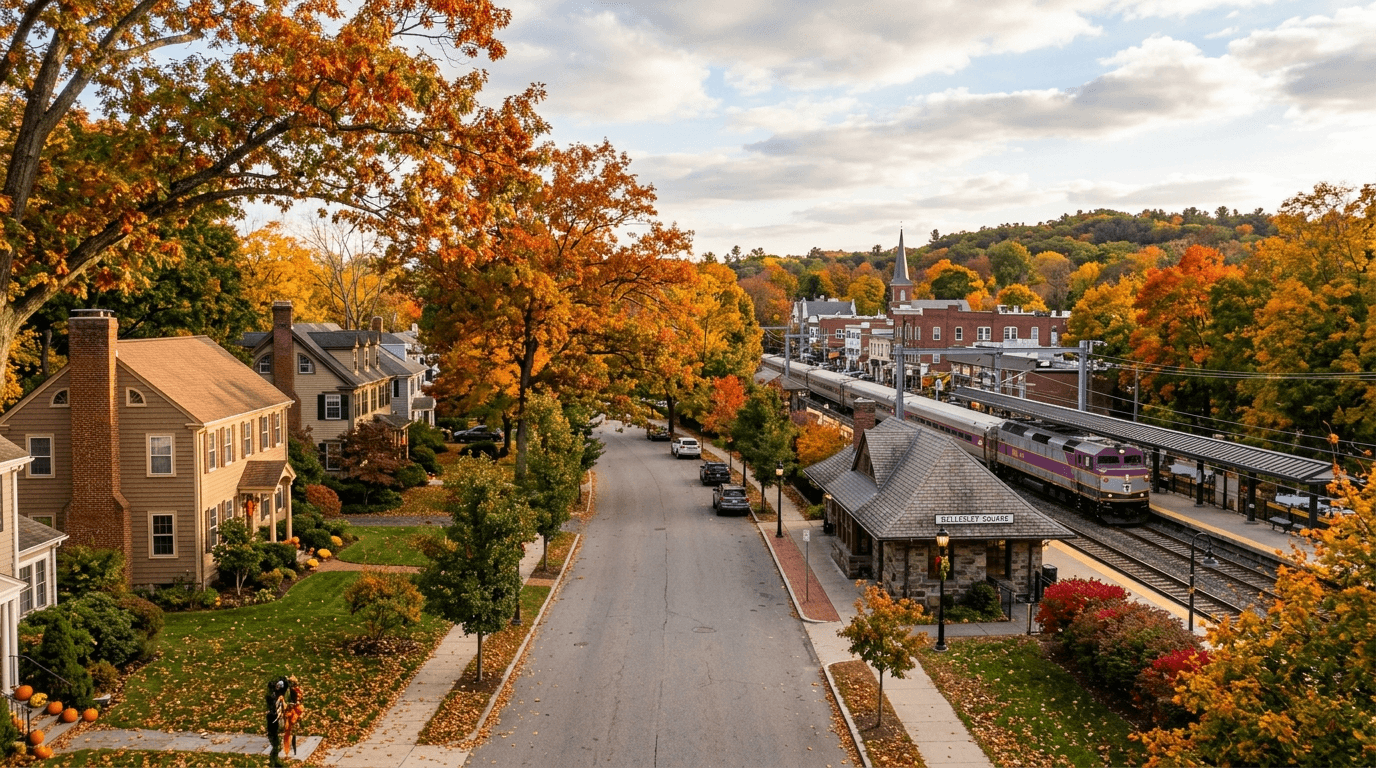
# Wellesley, MA: A Relocation & Logistics Handbook for Young Families
Moving with little ones is part thrill, part spreadsheet. When families sit down with me to talk through a possible move to Wellesley, the opening questions are almost always the same: How long is the commute? How close are the schools? And where do I grab milk on a Tuesday night? This guide walks through the real rhythms of daily life here — actual distances, honest travel times — so you can picture your week before you ever tape up a single box.
Wellesley earns its reputation as a wonderful place to raise a family, and the numbers tell the same story.
Wellesley Family Relocation Snapshot
A family-first hero card for relocating households: Wellesley ranks highly for families, carries top grades for schools and family fit, and has a population scale that supports a suburban community feel.
Wellesley
Rank#4
Population30,347
Overall Niche GradeAPlus
Public Schools GradeAPlus
Good for Families GradeAPlus
Average User Rating4.25 out of 5
Review Count61
With a population around 30,347 and straight-A marks for both public schools and family-friendliness, Wellesley delivers that quiet, tree-lined village feeling so many families tell me they're chasing — all without giving up easy access to the city.
How Is the Commute from Wellesley, MA to Downtown Boston?
Short answer: Most Wellesley commuters reach downtown Boston in about 30–35 minutes by commuter rail, or 35–50 minutes by car depending on traffic. It's a big reason Wellesley pulls an A-minus commute grade from the people who actually live here.
The Framingham/Worcester Line does the heavy lifting. Step on at any of Wellesley's three stations and you'll glide into South Station in roughly 30–35 minutes — enough time to clear your inbox, get lost in a book, or just breathe before the day begins.
Prefer to drive? Downtown Boston sits about 15 miles to the east. Take I-90 (the Mass Pike) and you're looking at 35–50 minutes door-to-door, with that wide range coming down entirely to when you hit rush hour. Families coming from denser, busier neighborhoods often tell me the same thing: trading the constant traffic hum for a calmer pace feels like a gift — especially when the city is still genuinely close by.
One detail I love sharing with clients is that you've got three commuter rail stations to pick from:
•Wellesley Square — central, walkable, and just steps from shops and cafés.
•Wellesley Hills — handy for the northern neighborhoods.
•Wellesley Farms — the closest stop to the Weston line and many of the historic estate streets.
Each station offers resident parking permits, which takes the daily scramble for a spot right off your plate. I always nudge families to apply early through the town — it's the simplest way to lock in a predictable, low-stress commute. Plenty of my clients start their mornings with a quick coffee from Quebrada Baking Company before catching the train. It's a small ritual, but it makes the whole routine feel a little more human.
How Close Are the Schools in Wellesley, MA?
Short answer: Most Wellesley homes sit within 1–2 miles of a top-rated elementary school, and Wellesley High School is typically a 5–10 minute drive (under 3 miles) from anywhere in town. The public schools earn an A-plus, and that grade is one of the biggest reasons families put down roots here.
When I'm touring homes with parents, schools are almost always question number one. The reassuring part? Wellesley's elementary schools — including well-loved options like Sprague and Bates — are woven right into the residential streets. From most historic neighborhoods, you're within a 1-to-2-mile radius of your assigned elementary school, often along walkable, tree-lined sidewalks with crossing guards posted at the busy corners.
Wellesley High School sits centrally, so even families on the outer edges of town are usually just a 5-to-10-minute drive away — under 3 miles. If you're planning ahead, kindergarten registration is open to children who turn 5 on or before August 31, 2026.
Parents often ask whether the schools are getting more crowded. The district's own projections point the opposite direction.
Wellesley Public Schools K-12 Enrollment Outlook
Projected K-12 enrollment scenarios help relocating families understand the school-system planning backdrop over the next several academic years.
Low Scenario
High Scenario
Both the Low and High scenarios show K-12 enrollment trending down from the 4,758 student baseline — the High Scenario easing toward roughly 4,462 by 2029-30, and the Low Scenario sliding further to 3,879. For parents, that usually means stable-to-improving class sizes, not the overcrowding squeeze you see in some fast-growing suburbs.
A few practical notes from the ground:
•Redistricting awareness. Wellesley rolled out an updated elementary enrollment plan in August 2024, so I always recommend confirming a specific home's current school assignment with the district before you lose your heart to a listing.
•Campus investment. The town keeps reinvesting in its schools — the Hunnewell Track & Field project broke ground in Fall 2025, a welcome sign for families who care about athletics and recreation.
•Childcare and enrichment. Beyond the public schools, the area is full of highly rated early-childhood and enrichment programs, which makes the transition so much smoother for younger siblings.
Compared with the more urban communities many of my clients are leaving behind, Wellesley offers something specific and reassuring: short, safe routes to school, and a real neighborhood feel where kids actually walk to class.
What Are the Day-to-Day Logistics Like for Families in Wellesley, MA?
Short answer: Groceries, pharmacies, and gas are all within a 5-minute drive of the town center, and Newton-Wellesley Hospital is just 3–4 miles away — so most daily errands take under 15 minutes. That everyday ease is the quiet luxury of living here.
Let's start with the grocery run, since that's the chore that shapes a whole week. Roche Bros and Whole Foods Market both sit within a 1-to-2-mile, roughly 5-minute drive of the town center, each with an in-store bakery for those last-minute birthday-cake emergencies. Pharmacies and gas stations cluster conveniently along Route 16 and Route 9, which keeps the daily loop — school, errands, home — tight and predictable.
Here's how the essentials shake out:
•Groceries: Roche Bros and Whole Foods, about 5 minutes from the center.
•Pharmacies: Multiple CVS locations along the main corridors for quick prescription and last-minute runs.
•Gas & errands: Stations clustered along Routes 9 and 16 — most errands wrap up in under 15 minutes.
•Healthcare: Newton-Wellesley Hospital, just 3–4 miles away.
For young parents, that hospital proximity is real peace of mind. Knowing a full-service hospital is just minutes from your front door changes how you feel about midnight fevers and the inevitable scraped knees of childhood.
But daily life here is about more than logistics — it has texture, too. Linden Square gives families a walkable hub for shopping and dining, and the Wellesley Free Library's Hills Branch is a beloved rainy-day refuge for story time and happy toddler chaos. Weekends tend to start at a neighborhood park and wind down with takeout from one of the town's many family-friendly spots.
What Should Families Budget for Housing in Wellesley, MA?
Short answer: Wellesley is a premium market — the median home value sits around $1,582,700, well above the national figure — and current inventory is historically tight. Setting expectations early helps families search with clarity instead of sticker shock.
Here's the housing-cost picture next to the national benchmark:
Current Wellesley Home Search Budget Benchmarks
A quick purchasing-planning snapshot for families budgeting a Wellesley move, showing tight inventory and the price band for existing homes versus new construction.
Inventory Statistics
Current Inventory StatusHistorically low
Price Range
Lowest Price$2M
Highest Price$4M
New Construction Prices
New Construction Low Price$4M
New Construction High Price$7M+
In today's market, existing single-family homes commonly land in the $2M–$4M range, while new construction generally starts around $4M and climbs to $7M+. Inventory is historically low, so when the right home surfaces, families who are pre-approved and ready to move tend to come out ahead.
One nuance I always pass along: Wellesley may be a luxury market, but it isn't always a frenzied bidding-war scene. Recent regional data put Wellesley's sale-to-list ratio around 98.5% — toward the more measured end of the Greater Boston spectrum.
Greater Boston Sale-to-List Ratio Comparison
Regional sale-to-list ratios show where buyers are paying above asking and where negotiation room has been more common. Wellesley’s 98.5% figure places it among the lower sale-to-list markets in this Greater Boston spring sample.
Top Performers
Bottom Performers
For buyers, that comparatively grounded ratio can mean a little more room to negotiate than in some of the white-hot, under-$1.1M markets where homes vanish over asking in under eight days. It's a meaningful difference worth understanding before you write an offer.
Relocating is a big leap, no question. But Wellesley makes the logistics genuinely manageable: a reliable commute, schools woven right into the neighborhoods, and daily essentials all within a short, calm drive. If you'd like help matching a specific neighborhood to your commute, your school preference, and your budget, I'd love to walk through it with you — in whatever language feels most comfortable. Welcome to Wellesley.