I'm Rahel Choi, a bilingual (English/Korean) Natick, MA real estate agent helping first-time buyers, families, and investors across MetroWest—from first search to closing. Serving Natick, Brookline, Cambridge, Wellesley, Ashland, Wayland, Southborough, Weston, Framingham, Sudbury, Boston, Newton and Needham, MA.
If you're relocating to Boston for a new job, one question cuts through everything else:
Where should you live so your life actually works?
For young professionals who want a short commute, real career access, and a genuine Boston lifestyle, two neighborhoods consistently rise to the top: Seaport and Back Bay.
Both put you within reach of major office clusters. Both let you trade a grinding MBTA ride for a walk. But both are expensive — and in mid-2026, the case for each is more nuanced than a simple "move here now" pitch.
Boston is still costly. Citywide rents have dipped slightly, which gives movers a bit more room to negotiate as of July 2026. But that dip is small, and it doesn't apply evenly across every apartment type.
The walk-to-work dream is real this summer. But the softer market is a thin edge, not a wide-open door — and it helps some renters more than others.
What are the key takeaways?
•The two neighborhoods to weigh: Seaport for modern waterfront luxury near tech, finance, and biotech offices, and Back Bay for historic brownstones with strong transit access.
•The market shift: Citywide average rent changed 1.54% over the past year to $3,713, per RentCafe's 2026 Boston data — but studio rents actually rose, meaning the smallest units are getting pricier, not cheaper.
•The trade-off: You pay a significant premium and get less space. What you're buying is a shorter commute — and only you can decide whether the time saved justifies the cost.
•The bottom line: Boston's vacancy rate has held under 1% since January 2022, per Steadily's 2026 report. This is a structurally tight market. The modest softening is real but limited. Compare premium neighborhoods against cheaper alternatives before you commit.
Why does Boston's rent dip matter for young professionals right now?
As a Realtor helping clients relocate to Greater Boston from across the country and abroad, I evaluate neighborhoods on three things:
Commute, lifestyle, and long-term value.
Right now, the numbers are doing something unusual — but you have to read them carefully.
Boston's citywide average rent shifted over the past year, moving from $3,772 to $3,713, a change of 1.54%, according to RentCafe's 2026 Boston rent data. That's a year-over-year comparison — measured against the same period last year.
That may sound small. In practice, it is small — roughly $59 a month off the citywide average.
Here's the catch that matters most for young professionals moving solo. The softening isn't spread evenly across apartment types.
By bedroom count, studio rents actually rose 2.70% year-over-year, while 3-bedroom rents changed -1.37%.
Year-Over-Year Rent Change by Bedroom Count
Year-over-year percentage rent changes by bedroom count in July 2026.
Year-over-year percentage rent changes by bedroom count in July 2026.
Read that again. Larger, more expensive units are getting cheaper. The smallest units — the most likely entry point for someone arriving in Boston on their own — are getting more expensive. The "softer market" story is weakest exactly where a solo young professional shops.
Demand is also still strong. Renter interest remained high in 2026 because of steady job growth, affordability pressure, and limited apartment supply, according to RentCafe's Renter Engagement Tracker via PropertyCasualty360 on July 8, 2026.
Renter-occupied households make up 64% of Boston households, compared with 36% owner-occupied — which helps explain why rental demand stays structurally elevated.
Boston Household Tenure
Share of Boston households that are renter-occupied versus owner-occupied.
TOTAL
Renter-occupied
64%
Owner-occupied
36%
Share of Boston households that are renter-occupied versus owner-occupied.
The vacancy rate has stayed under 1% since January 2022, per Steadily's 2026 Boston report.
That's an important reality check. A vacancy rate this low is, by definition, a landlord's market — and it has been this tight for more than four years.
Be honest with yourself about "leverage." A 1.54% shift doesn't flip the balance of power to renters. At best, it makes negotiating marginally less painful than it was at the 2021–2022 peak. In a handful of higher-end buildings with genuinely empty units, you may find a landlord willing to talk. But don't expect a soft market to rescue you on price.
Is Seaport one of the best Boston neighborhoods for young professionals?
Best for: modern waterfront living near tech, finance, consulting, and biotech offices.
Seaport is built for the walk-to-work crowd.
A decade ago, much of this area was parking lots and working waterfront. Today it's one of Boston's most modern neighborhoods — glass towers, hotel bars, waterfront parks, and Harborwalk access woven into a district that didn't really exist as a residential option a generation ago.
For many young professionals, the appeal is straightforward:
You can live near the office, the gym, dinner, and the water.
That lifestyle carries a price tag. Seaport has some of the highest rents in Boston and less historic character than older neighborhoods.
Two-bedroom units here are often quoted around $5,000/month, reflecting the waterfront premium, according to Steadily's 2026 data.
The upside is pure convenience. If your office is in Seaport, the Financial District, or nearby biotech and tech hubs, your commute may be measured in blocks.
But be clear-eyed about the math. At roughly $5,000 a month, a Seaport two-bedroom costs more than double a neighborhood like Mattapan, where rents sit near $2,279. That's a difference of about $2,700 a month — over $32,000 a year. To justify that gap on commute savings alone, you'd need to place a very high value on your time. If a shorter commute saves you five hours a week, you're effectively paying more than $100 an hour for that time. Run your own numbers before deciding the premium is worth it.
What this means for you: Seaport isn't the budget choice, and it isn't obviously the "smart" choice either. It's the time-saving choice. Whether that time is worth the cost is a personal calculation only you can make.
Pro Tip: If you're targeting a premium building, ask directly about units that have sat empty. In a sub-1% vacancy market, those are rare — but an empty high-end unit is where the limited negotiating room tends to live.
Is Back Bay still worth it for young professionals in 2026?
Best for: classic Boston living, beautiful streets, strong transit, and walkable city access.
Back Bay is the neighborhood that makes many newcomers fall in love with Boston.
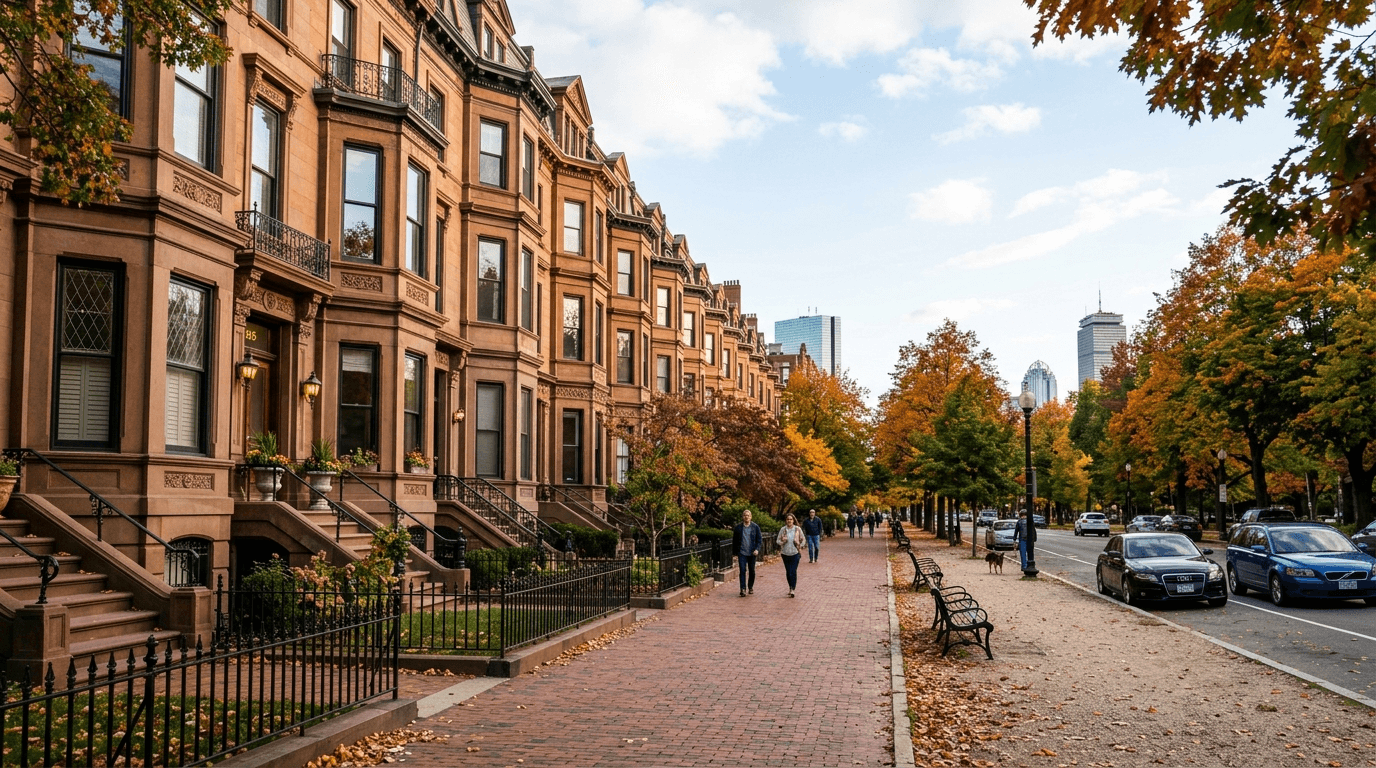
Tree-lined streets, historic brownstones, Newbury Street, Copley Square, cafes, shops, and easy access to the Charles River — it's a lot packed into one walkable footprint. For professionals who need flexibility, Back Bay also delivers. From here, you can reach the Financial District, Longwood, Cambridge, Fenway, and other job centers without much friction.
The honest downside is price.
Back Bay's average rent runs about $4,821, well above the citywide $3,713 average, according to RentCafe's 2026 data.
Average Rent by Boston Neighborhood
Neighborhood-level average monthly rents across Boston.
Neighborhood-level average monthly rents across Boston.
The chart shows just how wide the rent spread is across Boston.
Bay Village tops the list at $6,331, according to RentCafe's 2026 data, with Back Bay close behind. Meanwhile, neighborhoods like Mattapan sit near $2,279.
That spread deserves more than a footnote. Back Bay costs roughly $2,500 more per month than Mattapan. Over a two-year lease, that's approximately $60,000. A renter could live in Mattapan and redirect that difference toward savings, travel, or a down payment. The commute would be longer, but the money is real. The honest question is whether the shorter commute and the neighborhood feel are worth more to you than $2,500 a month.
What this means for you: In Back Bay, you're paying for location, architecture, transit, and lifestyle in one tight footprint. If those things matter more to you than the cash, the premium can be worth it. If they don't, a cheaper neighborhood with a longer commute may leave you better off financially.
Pro Tip: Before signing in Back Bay, tour at least one cheaper neighborhood with a longer commute. Seeing both makes the trade-off concrete instead of theoretical.
Why does walk-to-work living matter so much in Boston?
Boston's strongest mobility measure in this data is walkability.
The city-level Walk Score is 83 — higher than its Transit Score of 72 and Bike Score of 69.
Boston City Mobility Scores
Citywide Walk Score, Transit Score, and Bike Score for Boston.
Walk Score
Transit Score
Bike Score
Citywide Walk Score, Transit Score, and Bike Score for Boston.
One honest caveat: this is a city-level score. It tells you Boston overall is very walkable. It doesn't prove that Seaport or Back Bay are more walkable than cheaper neighborhoods — many Boston neighborhoods score well on walkability. So walkability alone isn't a reason to pay a premium for these two specific areas.
For busy professionals, commute time still compounds fast.
Among the commute-time brackets in this data, the largest is 30 to 59 minutes at 18%. The listed brackets cover only part of all commuters, with the remainder falling into categories not shown here.
Use this figure carefully. It's a citywide number and doesn't, by itself, show that Seaport or Back Bay residents commute less than residents of South End, Fenway, or other options. The real advantage of Seaport and Back Bay is proximity to specific job clusters — the Financial District, biotech, and downtown offices. If your office sits in one of those clusters, the walk-to-work benefit is concrete. If your job is elsewhere, the premium buys you less than you might think.
Every morning you don't spend transferring across the MBTA is time you get back — for work, sleep, fitness, errands, or seeing friends.
What this means for you: A shorter commute can genuinely improve your week, but only if the neighborhood is actually close to your specific office. Map your real commute before you pay for proximity you may not use.
How do premium rents look in a softer Boston market?
Seaport and Back Bay are expensive. They sit well above the citywide average, and the year-over-year shift gives renters only a marginally better position than during the tightest years. On these price levels, "slightly better" is exactly the right phrase. A 1.54% change on Back Bay's $4,821 average is roughly $74 a month.
Here's how the two compare with the citywide number:
Boston Premium Neighborhood Rent Comparison
Compares typical monthly rents for Bay Village, Seaport, Back Bay, and the Boston citywide average in the 2026 Boston rental market.
You may see Boston framed as a relative bargain next to pricier markets. New York City rents rose more than 6% over the year, while Dallas rents moved -2.9%, according to Realtor.com.
Be careful with that comparison. It's a relative one, and it can obscure the absolute cost. In plain dollars, the neighborhoods recommended here — Back Bay near $4,821 and Seaport near $5,000 for a two-bedroom — are priced like expensive parts of New York, not like a discount alternative. The fact that another city rose faster doesn't make your Boston rent affordable. Judge these neighborhoods on their actual price against your income, not against New York's trend line.
If you plan to stay several years, run the rent-versus-buy math as well. The market snapshot below covers single-family homes, condos, and a mixed category.
Boston condos carry a $725,000 median sold price, with a median of 29 days on the market — a straightforward measure of how long a typical condo takes to sell.
Boston For-Sale Market Snapshot by Property Type
A mixed-unit snapshot of median days on market, months of inventory, and median sold price for Boston property segments over the last 180 days.
The same snapshot shows single-family homes at a $1,094,000 median sold price. It also lists months of inventory — a measure of how long the current supply would last if no new listings arrived and sales continued at the recent pace. Condos sit at 18.0 months; single-family homes sit at 8.9 months. A low number signals tight supply, which is one more indicator that Boston remains a seller's and landlord's market.
What this means for you: Renting may be the right short-term move if you're new to Boston and still figuring out where your job and life will settle. Buying makes sense only when your commute, lifestyle, and budget are stable enough to commit.
What are the strongest arguments against Seaport and Back Bay?
The objections deserve a direct answer, not a footnote.
Are these neighborhoods simply too expensive?
The premium is real. Boston rents are high, and the priciest neighborhood in the RentCafe 2026 data — Bay Village — reaches $6,331 a month.
That can make Seaport and Back Bay feel out of reach, and for many people, they are.
The July 2026 market is only slightly friendlier to renters. Citywide average rent changed 1.54% year-over-year to $3,713, per RentCafe. That's a modest shift, not a reset.
For a professional in a well-paid tech, finance, consulting, or biotech role, Seaport and Back Bay may be realistic. For most others, they may not be — and that's a fair reason to look at cheaper neighborhoods with longer commutes.
The key question isn't whether the rent is "cheap." It's whether the time savings and lifestyle genuinely fit your budget.
Do you pay more money for less space?
Yes. That's the core trade-off.
In Seaport and Back Bay, you're paying for location, convenience, building quality, and neighborhood access — not extra square footage.
For a walk-to-work renter, the math is about time. If living closer saves you real hours each week, a smaller apartment may still be worth it. If it doesn't, you're paying more for less.
For rough context, RentHop's 2026 data puts the citywide per-square-foot benchmark near $47 for a two-bedroom. Treat that as a citywide reference point, not a Seaport-specific figure.
Honest concession: This analysis doesn't include a Seaport-specific per-square-foot figure. The space penalty in luxury towers could be worse than the citywide average suggests — that's a real gap in the cost-per-space case for Seaport. Don't treat the trade-off as settled. Tour the actual units, get the exact square footage, and do the math yourself before you sign.
How should you choose between Seaport and Back Bay?
A simple framework helps.
•Lean Seaport if you want waterfront-modern luxury, newer buildings, high-end amenities, and offices in biotech, tech, finance, or consulting nearby.
•Lean Back Bay if you want historic brownstone character, Newbury Street culture, deeper transit options, and a more established Boston feel.
•Look elsewhere if the premium doesn't clearly pay for itself in your commute. A cheaper neighborhood can be the smarter financial choice.
Think about your long-term plan too.
Back Bay has proven staying power. Its architecture, transit access, and location have held value for more than a century. Seaport is newer — exciting, polished, and still maturing as a residential neighborhood.
Neither is "better" for everyone.
Seaport is the sharper fit for modern convenience. Back Bay is the stronger fit for classic Boston lifestyle. A cheaper neighborhood is the stronger fit for your bank account.
Pro Tip: Tour both this summer, and tour at least one budget alternative. Comparing all three makes the true cost of the premium impossible to ignore.
Should you make a move in summer 2026?
If your goal is to live close to work in Boston, summer 2026 is a reasonable time to look — with clear eyes.
The rent shift is small and uneven. Studio rents rose. Larger units eased. Vacancy has been under 1% since January 2022, meaning this market has been structurally tight for years, not just this season.
Two things follow from that. First, don't expect a sudden window to slam shut on a fixed date — no single event is set to change this market overnight. Second, don't expect strong leverage either. A slightly softer patch is not the same as bargaining power.
Seaport and Back Bay both deliver what many ambitious young professionals are after:
A shorter commute to specific downtown job clusters, strong lifestyle access, and a front-row seat to Boston's career economy.
Seaport gives you waterfront newness. Back Bay gives you brownstone character and top-tier transit.
But both ask you to pay a lot for that proximity. The smartest move isn't to rush — it's to price the trade-off honestly against a cheaper alternative and your own commute numbers.
If you want help comparing Seaport, Back Bay, and more affordable Boston neighborhoods, reach out. I work with buyers, renters, and investors across Boston and nearby towns, and I can help you run the real trade-offs before you tour a single unit.
Common Questions
What are the best neighborhoods in Boston for young professionals right now?
Seaport and Back Bay are the best neighborhoods Boston young professionals should compare right now if they want to walk to work. Seaport fits modern waterfront living near tech, finance, consulting, and biotech offices. Back Bay fits classic brownstone living, strong transit, Newbury Street, Copley, and easy access to downtown jobs.
Is Seaport Boston real estate worth the high rent in summer 2026?
Seaport Boston real estate is worth considering if your job is nearby and you value time more than extra space. The article says two-bedroom units are often around $5,000/month, but citywide rent fell 1.54% to $3,713. That softening gives renters slightly more room to negotiate in premium towers.
How does Back Bay compare with Seaport for a walk-to-work lifestyle?
Back Bay offers historic charm and deeper transit, while Seaport offers newer waterfront buildings close to tech, finance, consulting, and biotech offices. Both Boston MA neighborhoods work for a walk-to-work lifestyle. The choice is mainly between Back Bay’s brownstones and Newbury Street culture versus Seaport’s modern towers and Harborwalk access.
Will Boston rents keep giving young professionals leverage?
Boston rents are giving movers limited leverage now, not a guaranteed long-term break. The article says average rent fell 1.54% year over year to $3,713, but apartment vacancy has stayed under 1% since January 2022. In tight Boston MA neighborhoods, that soft window may close quickly.
How should I choose between Seaport and Back Bay?
Choose Seaport if you want waterfront luxury, new-build amenities, hotel bars, and offices a few steps away. Choose Back Bay if you want brownstone character, Newbury Street, river access, and stronger transit. Among the best neighborhoods Boston offers, the right pick comes down to commute, lifestyle, and long-term value.
Can buying make sense instead of renting in these neighborhoods?
Buying can make sense if you plan to stay several years and want to compare rent versus ownership. The article notes Boston condos have a $725,000 median sold price and move in about 29 days. For premium Boston MA neighborhoods, buyers should weigh monthly cost, commute savings, and long-term plans.